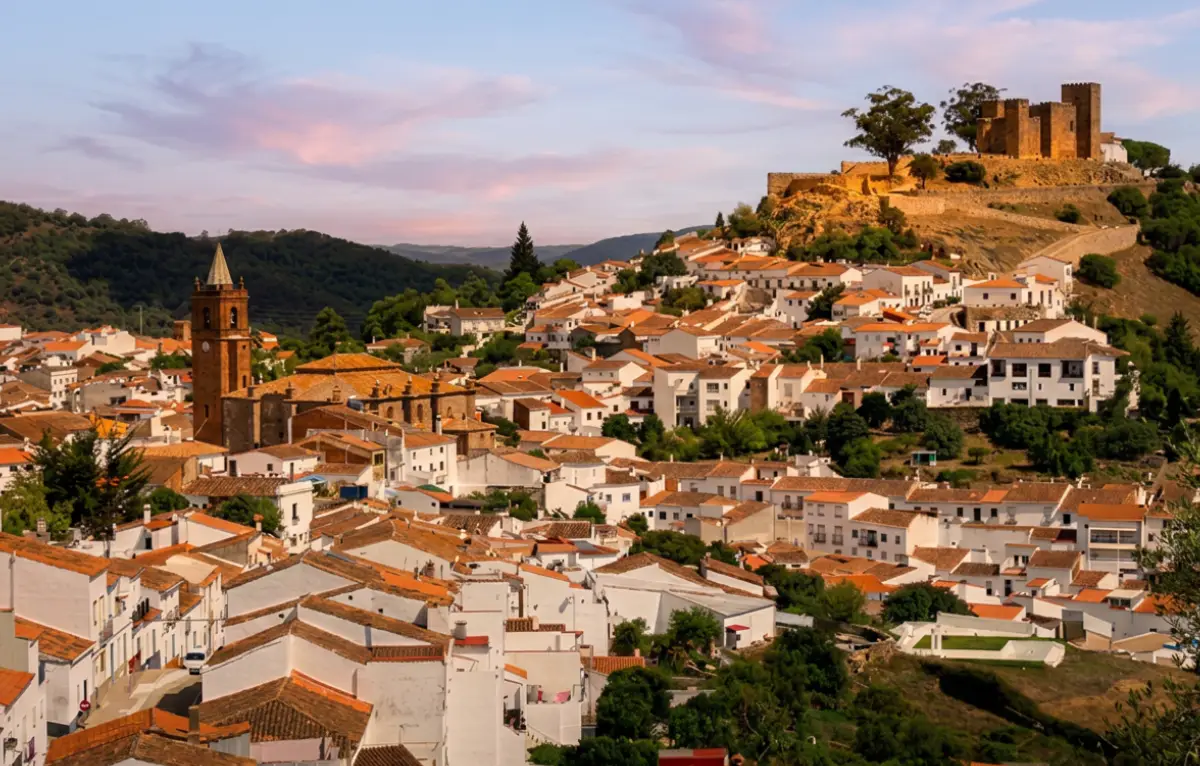
The Castle of Cortegana sits on a hilltop in the Sierra de Aracena, 1,200 meters above sea level, positioned at the precise moment where three territories collide: Christian Spain to the north, Islamic Granada to the south, Portugal to the west.
From the ramparts, you can see all three simultaneously.
That's not accident. That's strategy.
What the castle reveals—if you spend enough time on those ramparts to understand what you're looking at—is something most military history misses: power isn't about dominating one space. It's about understanding multiple spaces and moving between them without losing your footing.
That's what frontiers teach. And Cortegana was built to be a frontier.
Standing Between Worlds
Imagine being a young soldier assigned to Cortegana in 1200 AD. You arrive at a fortress positioned at the edge of three territories, none of which is fully yours. Your job isn't to conquer any of them. Your job is to hold the space between.
Every morning, you look north and see Christian Andalusia organizing itself around Church and Crown. Church bells ringing. Roads radiating from monasteries. Power flowing through established hierarchies.
Every morning, you look south and see the Islamic Emirate of Granada—different architecture, different organization of space, different economic systems, different power structures.
Same morning. Different worlds. Both visible from where you stand.
Most soldiers find this disorienting. The fortress doesn't pick a side. It holds the space between sides. That requires a different kind of thinking than conventional military position offers.
You can't reduce complexity. You have to navigate it.
What Cortegana teaches—through its stone, through its positioning, through the very fact that it endured for 800 years at this intersection—is that the frontier is where clarity collapses and you have to think more carefully because the stakes require it.
This matters. Not just historically. Psychologically. The people who learned to think at Cortegana were learning to hold contradictions.
To see multiple perspectives simultaneously. To operate in ambiguity without being paralyzed by it.
That's a rare form of intelligence.
Ready to stop photographing castles and start understanding them?
Every INNYOU journey is designed from scratch — no groups, no scripts, no rush. Tell us what you're looking for and we'll design your Sierra de Aracena immersion.
The Forest Is the Civilization
When you hike through the Sierra de Aracena (and yes, you hike, not drive through it), you realize the forest is the civilization.
The chestnut trees here aren't random. They're managed. Cultivated. For centuries, this forest has been a resource base—chestnuts for food, wood for construction, acorns for animals. It's sophisticated land management that looks like wilderness.
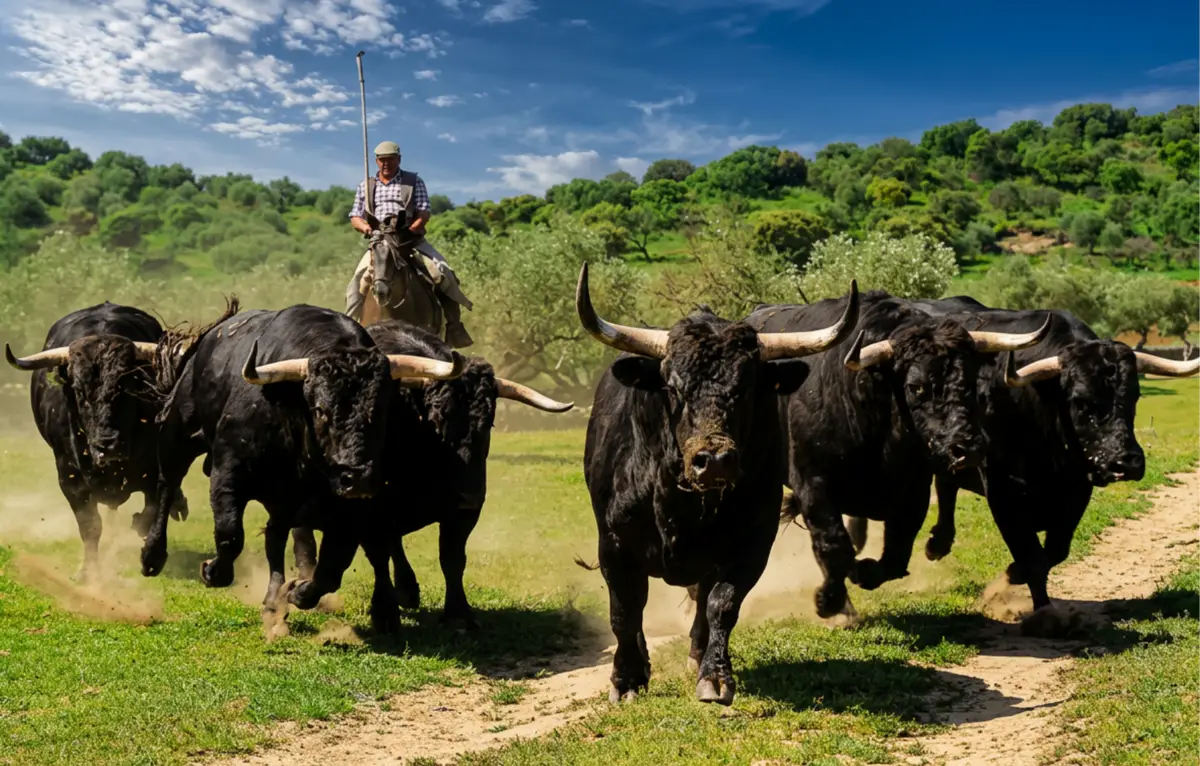
This is where the Iberian pigs live. Free-range luxury for 4-5 years, grazing on acorns, moving through forest, living better than most humans. The ham they produce isn't expensive because it's rare. It's rare because it's impossible to scale. You can't industrialize this. The forest dictates the rhythm. The climate dictates the timing. The centuries-old traditions dictate the process.
When your guide walks you through this landscape—explaining the relationship between animal, forest, history, and food—you stop seeing rural Spain as backward. You see it as strategically different.
These people didn't fail to modernize. They chose not to, because they understood something modern agriculture is only now realizing: profit and ecosystem health can actually align.
The forest feeds the animals. The animals sustain the forest. The forest sustains the people. It's not primitive. It's sophisticated.
The Frontier Never Left
When you walk through the Sierra de Aracena surrounding the fortress, you're not walking through wilderness. You're walking through a managed system so sophisticated it appears natural.
The chestnut trees aren't random. They're cultivated. For centuries—maybe longer—these forests have been engineered to serve human purposes while maintaining ecological integrity. Chestnuts for sustenance. Wood for construction. Space for animals. Water sources protected and distributed. Seasons respected.
The Iberian pigs that graze here live better than most humans. Four to five years of free range through oak forests, eating acorns, moving according to seasonal availability, living in relationship with the landscape rather than against it.
From this pigs come the jamón—acorn-fed Iberian ham so rare that a single cured ham costs as much as a month's rent. But "rare" is the wrong word. It's not rare because of artificial scarcity. It's rare because you can't industrialize it. The forest determines the pace. The climate determines the timing. The animals determine the rhythm.
This is what modern agriculture is only now learning: profit and ecosystem health aren't opposites. They can align. If you're willing to work with natural systems instead of against them.
The fortress of Cortegana sits at the center of this managed landscape. It's not separate from the forest. It's the forest's focal point. The stone at the center of the living system.
When you understand this—when you see that the people who built Cortegana were also the people who managed this forest, cured this ham, sustained this ecosystem for centuries—you stop seeing the castle as a military artifact. You see it as evidence of a civilization that understood how to live.
Not romantically. Actually.
If Cortegana's medieval frontier captivates you, there's another layer you can't afford to miss.
Just a few miles away, the Knights Templar left a footprint most travelers don't even know exists in Andalusia. Same mountains, same depth, another chapter of comprehension.
The Knights Templar and the Question of Knowledge
Here's what most castle tours don't mention: the Knights Templar held Cortegana.
Not constantly. But in the 12th and 13th centuries, when the Templars were at their height, when they were moving between Christian and Islamic worlds with the same easy access that Cortegana's position allowed, this fortress was one of their strongholds.
The Templars were doing something unusual for a military order. They weren't just defending territory. They were managing information flow. Understanding trade routes. Accessing systems—economic, political, spiritual—that moved through frontiers.
They understood that real power doesn't come from controlling a single space. It comes from understanding what moves through multiple spaces and how to position yourself at the intersection.
Look at Cortegana's architecture through this lens and it changes what you're seeing.
The Keep (Torre del Homenaje) isn't designed to be impregnable. It's designed to see threats from three directions simultaneously. The interior chambers—storage, chapel, administrative spaces—aren't built for spectacle. They're built for function. Efficiency. Control.
The fortress was positioned to watch, not to dominate.
That's different architecture than most medieval castles. Different strategy. Different understanding of what power is and how it actually works.
When the Templar order was destroyed in the early 14th century—systematically dismantled by Philip IV of France—something that had been protected at Cortegana left with them. Historical records are incomplete, but we know Templars on the Iberian Peninsula had warning. We know they moved assets. We know significant treasures disappeared into protected territories.
What was protected? We can only guess.
But stand on the ramparts of Cortegana and consider: what belief would make someone—a young soldier, a knight, a clerk—decide that something here was worth protecting? Worth dying for? Worth moving across dangerous territories to preserve?
That question sits at Cortegana. Unanswered. Still asking.
What Lunch Teaches You
In Cortegana, lunch isn't a meal. It's a philosophy made edible.
It starts at 2 PM. It ends at 5 PM. That's not approximate. That's the rhythm of the place.
You sit. You eat. You talk. You don't rush.
The guisados—slow-cooked stews—aren't quick because they're efficient. They're slow because the meat requires time. The flavors require time. The community gathered around the table requires time.
The jamón is sliced thin enough to be translucent. Each slice is a separate ritual. Placed on bread still warm from the oven. Tasted slowly. Understood as connection to the forest, the animal, the centuries of knowledge embedded in the curing process.
The wine is local. Not famous. Just what grows in these mountains and has been drunk here for generations.
When you understand the context—that this food comes from the forest surrounding the fortress, that the tradition of eating this way is connected to the ancient rhythms of the place, that the people who eat this way have sustained this civilization for centuries—lunch becomes more than sustenance.
It becomes evidence of a different way of organizing time.
Modern life optimizes for speed and scale. This place optimizes for depth and rootedness. Neither is objectively "better." But the difference is profound.
After lunch in Cortegana, after sitting for three hours and eating food that tastes like place, you return to the fortress with changed eyes.
You're not looking at medieval architecture. You're looking at a system. Fortress protecting forest. Forest sustaining animals. Animals producing food. Food organizing community rhythms. Community maintaining the land that sustains the forest.
It's not separate pieces. It's one integrated understanding of how to live.
The Frontier Never Left
Here's what most tourists don't understand about Cortegana: it still feels like a frontier because it still functions like one.
Physically, it's 30 kilometers from Portugal. Culturally, it's at the edge of something. The way people organize themselves, the rhythms they live by, the food traditions, the respect for land—these haven't been radically disrupted by modernity because isolation preserved them.
This isn't nostalgia. This is functional preservation.
When you spend time here, you realize that "progress" and "tradition" are usually presented as opposites. Either you modernize or you stay backward. Cortegana suggests a third option: you choose your progress carefully, based on what actually improves life rather than what simply accelerates it.
The people here didn't refuse modernization because they were afraid of change. They were selective about which changes served their actual values.
That's a different kind of intelligence than you find in places that've accepted every "advancement" without question.
Standing on the ramparts, watching the light change across three territories, you understand something: the frontier teaches clarity. Not because life is simple there. Because life is complex and you have to think carefully to navigate it.
The people who lived at Cortegana—the soldiers, the Templars, the communities sustaining the fortress and the forest—these weren't unsophisticated people. They were people who understood systems. Ecology. Power. Time. Human nature.
They organized themselves accordingly.
What the Architecture Reveals
When you've spent time in the forest, eaten the food, understood the ecological system supporting the fortress, then walking through Cortegana's stone takes on different meaning.
The corridors make sense. Not as decoration. As function. The Keep's positioning isn't random. The underground cistern (Aljibe) isn't a nice feature. It's survival—water and provisions protected during siege.
The Chapel of Our Lady inside the fortress walls isn't quaint. It's recognition that even military outposts require spiritual infrastructure. Even people organized purely for defense need meaning.
Every architectural choice becomes legible once you understand what problem it was solving.
This is what transforms castle visits from tourism to education: understanding why things were built the way they were. Seeing architecture as evidence of thinking.
The fortress reveals that its builders understood:
- Geography as destiny (position yourself where power flows)
- Ambiguity as advantage (frontier thinking teaches flexibility)
- Systems as more important than spectacle (function over impression)
- Time as a resource (sustainability matters more than rapid growth)
- Community as survival mechanism (none of this works without coordination)
These aren't medieval thoughts. These are perennial human insights that industrialized civilization has mostly forgotten.
Cortegana remembers.
The Question That Remains
When you leave Cortegana—after walking the forest, eating slowly, standing on ramparts that overlook three worlds, touching 13th-century stone—you don't leave having "conquered" it.
You leave carrying a question.
What does a society look like when it prioritizes depth over speed? When it organizes itself around actual place rather than abstract efficiency? When it views nature as partner rather than resource?
Cortegana doesn't provide the answer. It provides the evidence that someone, somewhere, tried. For 800 years, sustained it. Created a civilization that was sophisticated, sustainable, resilient.
That civilization isn't gone. The fortress stands. The forest remains. The people still eat their three-hour lunches. The tradition persists.
What it teaches is this: the frontier—the place where you have to think between contradictions, where you can see multiple systems simultaneously, where you can't afford simplification—that's where clarity actually emerges.
We've built our world on the opposite assumption. Speed and scale over depth and place. Efficiency over sustainability. Individual advancement over community survival.
Cortegana sits there, in the mountains, offering an alternative thesis.
Not as ideology. As evidence. In stone. In forest. In the flavor of jamón that tastes like centuries of knowledge about how to live in one place and have it still be there for the next generation.
When you're ready to investigate what a frontier teaches—not as historical tourism but as living question—Cortegana is waiting.
The forest is waiting. The fortress is waiting. The people who live there, eating their three-hour lunches, are waiting.
The question is: are you ready to stop visiting places and start learning from them?
This isn't a tour package. It's access.
Access to jamón producers who don't show up in guidebooks. To forests you can only understand by walking them. To a way of living that changes how you see your own. If you're after real comprehension — not the "authentic experience" hashtag — let's talk.