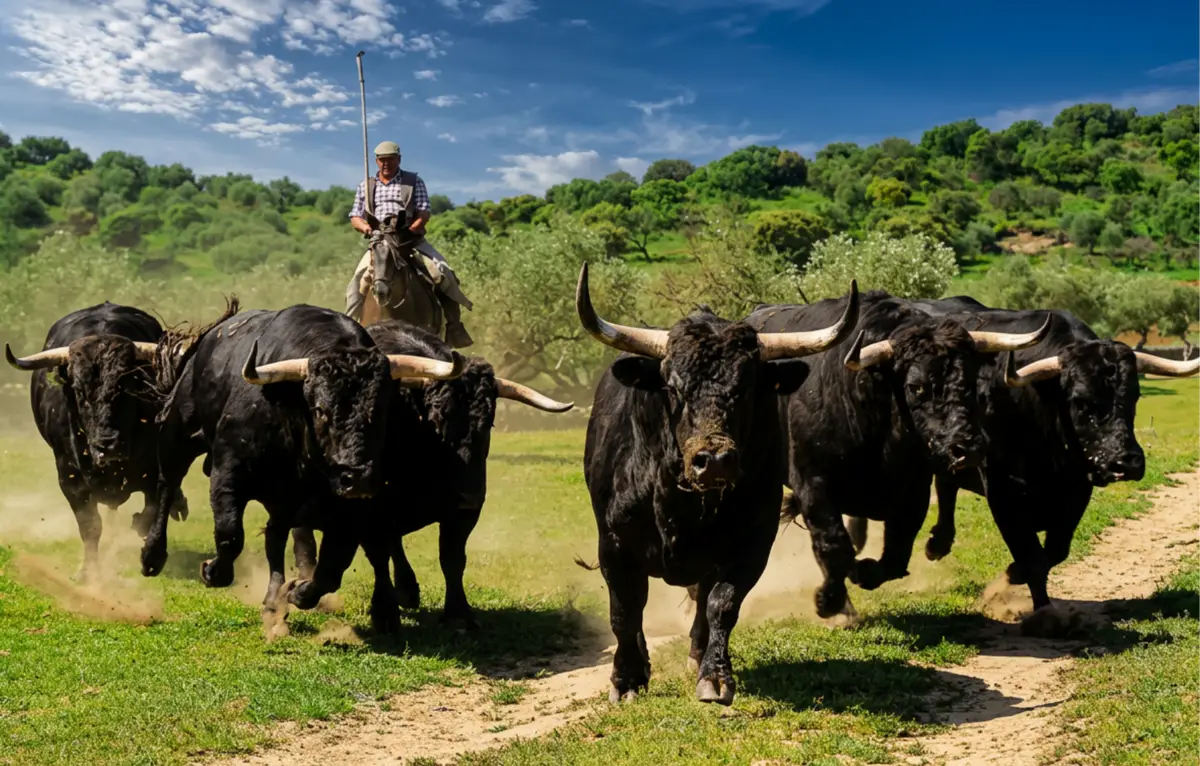
You're standing in a field at sunrise. The Andalusian air is still cool. Around you, silhouettes of black bulls graze against golden grassland—not behind fences, not separated by tour-bus glass, but present. Real. Close enough that you can hear their breathing.
One of them notices you.
The ganadero—the man who's spent his life with these animals—doesn't move. He simply watches. Waits. There's no tension in his body. No attempt to control the situation. Just presence.
The bull watches back. For a moment, the hierarchy is clear: you are not in charge here.
Then the bull returns to grazing. The moment passes. But something has shifted in how you understand power.
Most travelers come to Spain and never experience this. They see Spain through glass. Through photographs. Through guidebooks written by people who've also seen Spain through glass.
But this—standing in a field with an animal that could kill you, learning to move carefully through a space you don't control—this is where real understanding begins.
The Animal That Refuses to Be Tamed
The Toro Bravo is not a tourist attraction. It's not a spectacle bred for entertainment. It's a thesis about what happens when you refuse to be controlled.
For centuries, this breed has existed at the center of Spanish culture. Not as a symbol of conquest or domination. As a symbol of unconquered power. An animal that cannot be domesticated. Cannot be broken. Cannot be made to perform.
In a land shaped by empire and control, the Toro Bravo represents the refusal to be controlled. That's why it matters culturally. That's why families breed these animals with the reverence most cultures reserve for sacred objects.
When you spend a morning at a working ganadería, you begin to understand what that reverence actually means.
These bulls are raised in free range for four to five years. They're not confined. Not forced. They're allowed to develop according to their nature. Which means they're wild. Aggressive. Powerful. They've never accepted human dominance and never will.
The ganadero doesn't see this as a problem to solve. He sees it as the entire point.
Listen to how a man who's spent forty years with these animals talks about them. Not with the condescension of a handler toward a subject. With the respect you'd show to a force of nature. An acknowledgment that this animal operates according to its own logic, and the ganadero's job isn't to override that logic but to understand it. Work within it. Accept it.
That's a different kind of relationship than most humans have with nature.
Ready to stand in a field at sunrise instead of a museum line?
Every INNYOU journey is private, unscripted, and built around access most travelers don't know exists. Tell us what kind of Spain you're looking for.
What Respect Actually Means
Here's where most people misunderstand the word "respect."
In modern contexts, respect usually means politeness. Following social conventions. Treating something nicely as a social gesture.
But there's an older, deeper meaning that the ganadero still practices: respect means I acknowledge that you have power. I recognize that power. I arrange my actions around that reality.
The Toro Bravo teaches this meaning viscerally.
When you're standing thirty meters away from an animal that weighs 600 kilograms and could charge you without warning, you stop performing respect as politeness. You become respectful because your survival depends on it. You watch carefully. You move slowly. You don't assume you're in control.
This is what transforms you.
Most people move through the world believing they're the center of their own experience. You're the agent. You make decisions. You control your environment. This is the dominant modern narrative about human agency.
The ganadería reveals something different: you're not always in control. Sometimes you're in a space with forces more powerful than yourself. Sometimes wisdom means accepting that and moving accordingly.
The ganadero wakes up every morning and practices this. He's not traumatized by the animal's power. He's grounded by it. He makes decisions based on reality rather than fantasy about how much control he actually has.
That's psychological sophistication that modern life rarely teaches.
The Dehesa as Evidence of Different Knowledge
The landscape surrounding the bulls is called the dehesa—a UNESCO-recognized ecosystem that's been refined over centuries.
This isn't a ranch in the conventional sense. It's not a farm that extracts value from nature. It's a working relationship between human intentionality and natural systems.
The ancient cork and oak forests remain because they provide acorns for the bulls. The bulls graze and their presence maintains biodiversity. The soil stays healthy because the system is designed around sustainability rather than maximum yield.
This is what happens when a civilization stops trying to dominate nature and starts trying to coexist with it.
Modern agriculture operates on a simple principle: control nature to maximize output. Burn the forest for farmland. Drain the wetlands for irrigation. Concentrate animals in confined spaces for efficiency. The entire system is built on domination.
The dehesa operates on a different principle: understand nature's logic and position yourself within it.
The bulls need acorns. Plant oak forests. The forests need grazing animals to maintain them. Raise bulls. The bulls need space to develop their nature. Don't confine them. The ecosystem needs water sources to persist. Protect springs and streams. Centuries later, you have a landscape that sustains itself.
This isn't romantic. It's pragmatic. It's sophisticated land management that modern environmentalism is only now learning to recognize.
When you walk through the dehesa with someone whose family has stewarded this land for generations, you see evidence of knowledge that doesn't get taught in business schools or agricultural colleges. It's the knowledge that comes from paying attention. From listening to what the land requires. From refusing to impose your will and instead adapting your will to what actually works.
The Toro Bravo exists because someone, centuries ago, made a choice: we will work with this animal's nature rather than against it. That choice—repeated across decades and centuries—created both a breed and an ecosystem.
That's the thesis the dehesa demonstrates: coexistence is possible if you're willing to respect the forces you're working with.
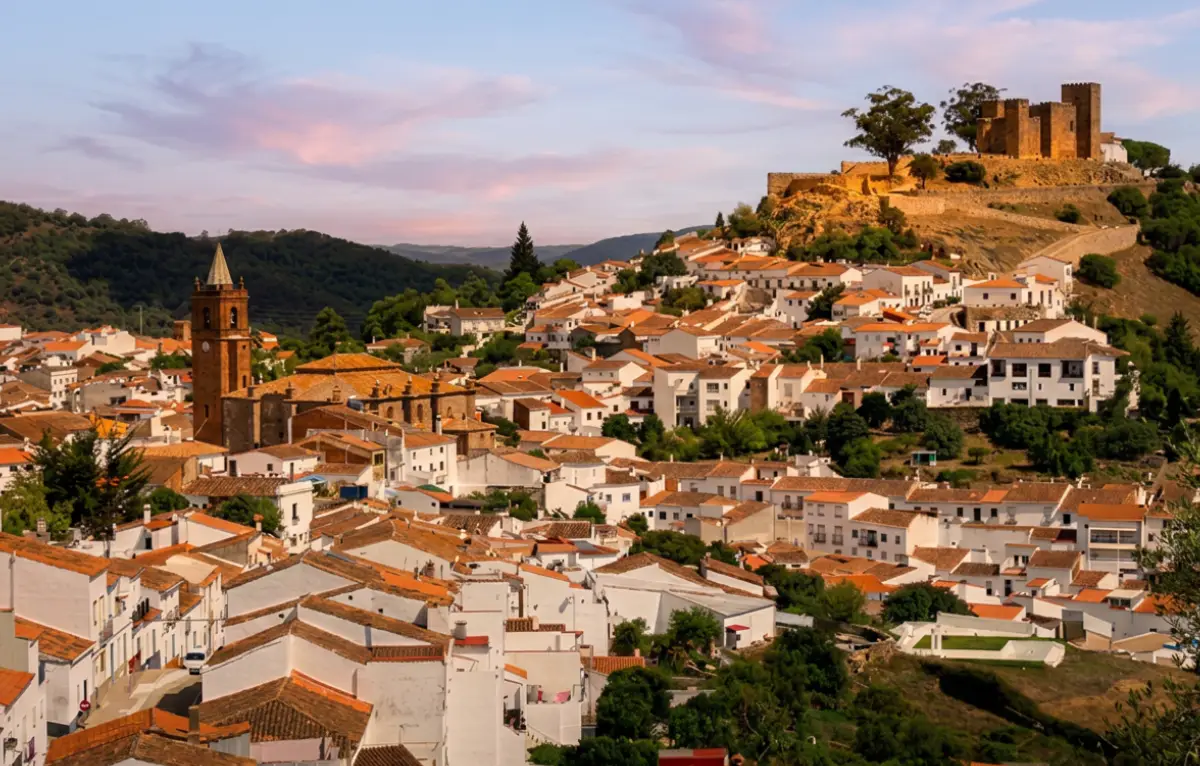
If the dehesa ecosystem fascinates you, the Sierra de Aracena takes it further.
Same philosophy, different chapter — medieval fortresses, centennial forests, and the jamón Ibérico tradition that's impossible to understand without walking the land it comes from.
The Hierarchy Within the Herd
Spend enough time watching the bulls graze and you start to see something that the ganadero has been reading for decades: social structure.
There's a Mayoral—a leader bull whose genetics are considered superior. There are followers. There are challengers to the hierarchy. There's constant, subtle negotiation about who leads and who follows.
This isn't random bullish behavior. It's organized. Intelligent. Predictable once you understand the patterns.
The ganadero knows every animal by name. Not as sentimental attachment, but as functional necessity. He knows which bulls will challenge authority. Which ones are protective of the young. Which ones are unpredictable. Which ones are steadily reliable. He reads the herd the way a sailor reads weather—not to control it, but to navigate it.
This is where breeding for the Toro Bravo becomes something other than ranching. It becomes genetics applied with intention over generations.
Thirty generations of selective breeding means you're not just raising an animal. You're sculpting the expression of power across centuries. You're choosing which traits matter: courage, aggression, independence, physical strength. You're saying—through your choices—what power looks like.
That's not simple animal husbandry. That's a civilization encoding its values into living form.
When you watch the hierarchy play out in the herd, you're watching Spain's relationship with power made visible. The refusal of domination. The acceptance of natural hierarchy. The willingness to let forces larger than yourself determine the landscape while you position yourself strategically within it.
From Field to Table: The Completion of Understanding
After a morning in the field—after standing with the bulls, learning to move carefully through a space you don't control, understanding what respect actually requires—there's a meal.
This is crucial. This is where the experience completes itself.
The Rabo de Toro is slow-cooked oxtail. The meat has been transformed through hours of heat and care into something entirely different from what it was. It's tender. Complex. Nourishing.
You eat this after watching the animal in its strength. In its freedom. In its refusal to be domesticated. And you understand something that most people eating meat never grasp: this transformation requires respect.
Respect for what the animal was. Respect for the land that sustained it. Respect for the generations of knowledge embedded in the recipe. Respect for the fact that nourishment comes from forces we don't control and didn't create.
Modern food culture obscures this. You eat chicken that was never allowed to move. Beef from cattle confined in concrete. Vegetables grown in monoculture after topsoil is destroyed. The entire system is designed to hide the cost of your consumption.
The meal at the ganadería shows a different approach.
The animals are wild. The land is sustainable. The preparation honors what the animal was. The eating becomes education rather than consumption.
This is where most travelers stop understanding Spain—because they never get past the restaurant experience, the curated version, the interpretation.
But if you've spent a morning in the field, watched the hierarchy, felt the weight of an animal's attention on you—then the meal isn't about flavor. It's about completion. It's the final chapter of understanding coexistence.
The Ganadero's Knowledge
The man who tends these bulls has probably never read a book on animal psychology. Probably never studied ecology formally. Probably never sat in a classroom about land management or sustainable agriculture.
What he has done is pay attention. For decades. To patterns. To what works. To what the land requires. To what the animals teach.
This is knowledge. Real knowledge. The kind that doesn't come from schooling but from sustained attention to living systems.
Modern culture treats formal education as the primary source of expertise. If you haven't read books about it, you're not knowledgeable. But the ganadero's knowledge—the understanding of how to maintain an ecosystem, how to read animal behavior, how to make decisions that sustain rather than extract—this knowledge is encoded in practice.
It's the knowledge that survives in families. That passes from father to son. That gets refined through centuries of attention and adjustment.
When you spend a morning with someone like this, you encounter a different kind of intelligence than what universities teach. Not less sophisticated. Different. More integrated. More ecological. More realistic about human limitations.
This matters because modern culture desperately needs what the ganadero knows. Needs the understanding that coexistence requires accepting limits. Needs the sophistication to work within systems rather than trying to dominate them. Needs the humility to admit you're not in control and move accordingly.
The ganadero isn't backward because he hasn't modernized the way society expects. He's forward-thinking because he's understood something that modern civilization is only now learning it forgot.
The Question the Toro Asks
Standing in that field, watching the bull notice you and evaluate whether you're a threat, you encounter a fundamental question.
What does it mean to respect something?
Not as social performance. Not as cultural gesture. But as a reality-based relationship with forces more powerful than yourself.
The ganadero practices this every day. He wakes knowing that he doesn't fully control the animals he tends. That the land has its own logic. That the ecosystem makes demands he can't override. And he's organized his life around accepting those realities.
Most modern humans haven't had this experience. We live in environments so controlled, so designed for our convenience, that we forget there are forces we don't control. We forget what it means to move carefully through a space that doesn't necessarily welcome us.
The Toro Bravo teaches this memory.
It teaches that respect is earned through attention. That power exists outside human intention. That wisdom means adapting yourself to what actually is rather than demanding the world conform to what you want.
This isn't philosophy. It's lived practice. And the ganadería is the university where you learn it.
What Remains After the Morning Ends
You don't leave the ganadería having "conquered" it or "experienced" it as a tourist memory.
You leave carrying a question.
What would change in how you live if you actually accepted—not just intellectually but viscerally—that you're not in complete control? That there are forces more powerful than your will? That wisdom means working with those forces rather than against them?
The ganadero has answered that question through his life. He's organized his society around respect. Around coexistence. Around the understanding that the Toro Bravo isn't a problem to solve but a force to understand.
Weeks after visiting the ganadería, you'll be reading about environmental collapse and suddenly think: the ganadero understood this. About how to live without destroying. About how to build systems that sustain themselves. About how profit and ecology don't have to be enemies if you're willing to work with nature instead of against it.
Months later, you'll encounter a conversation about power and control, and you'll find yourself thinking about that bull. About what happened to your certainty about being in charge when you stood thirty meters away from 600 kilograms of unconquered animal.
That shift—from believing you control everything to accepting that you operate within systems larger than yourself—that's not just a change in perspective. That's how transformation actually works.
The Toro Bravo doesn't teach you through information. It teaches you through presence. Through the visceral experience of standing in a space where you're not the dominant force.
And that experience changes what you're capable of understanding about everything that comes after.
The Invitation
If this resonates—if you're ready to stop experiencing Spain through guidebooks and start understanding Spain through your own encounter with what it actually is—the ganadería is waiting.
Not as a tourist attraction. As a teacher.
Not as an experience to consume and photograph. As a question to sit with.
The bulls are there. The land is there. The ganadero is there, watching, understanding, embodying a kind of knowledge that modern life rarely produces.
When you're ready to be in that field at sunrise, to feel what it means to be in a space you don't control, to learn what respect actually requires—the gates open.
The investigation begins when you're ready.
This isn't a tour you book. It's a conversation you start.
Private ranches. Families who've stewarded this land for generations. Gates that only open through relationships built over 70 years. If you're the kind of traveler who asks why, not just what — let's design your access to the real Andalusia.