
Megalithic Gateways: A Private Journey to the Antequera Dolmens
What happens when you stand inside a 5,700-year-old stone chamber with a historian who believes ancient civilizations knew far more than we've been taught.
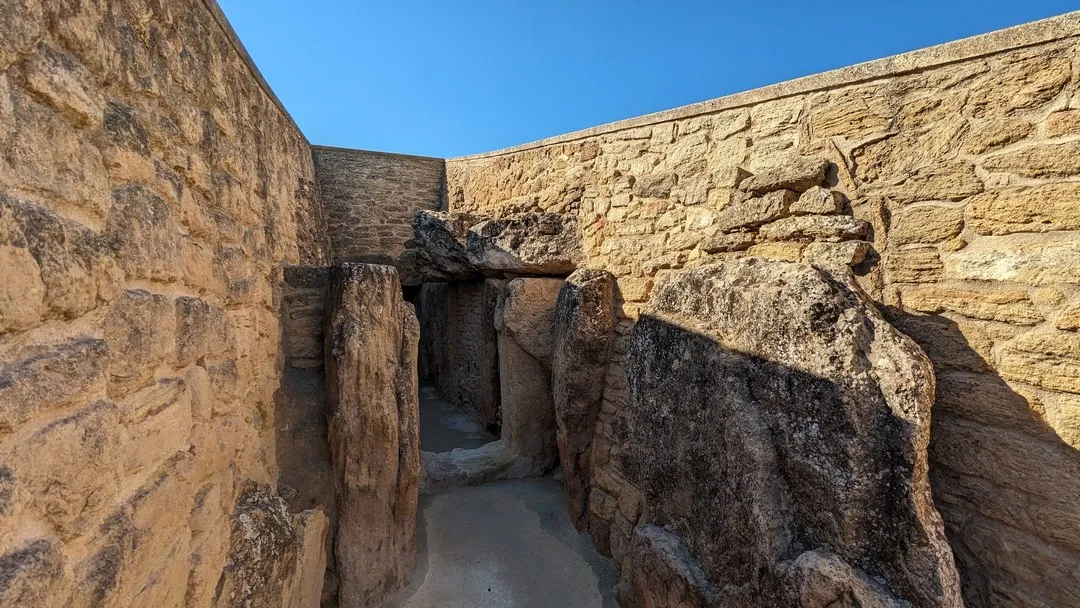
The first time I entered the Menga dolmen, I made the mistake every visitor makes: I looked up. I counted the massive stone slabs overhead. I tried to calculate their weight. I did what tourists do — I measured the place with my mind.
It wasn't until I stood still, stopped thinking, and simply listened that Menga revealed what it actually is. Not a monument. Not a tomb. A declaration. Someone, nearly six thousand years ago, decided that this precise point on the earth deserved a cathedral of stone — and they built one that still stands.
After four decades guiding travelers across four continents, I can tell you this: the Antequera dolmens belong in the same conversation as Stonehenge, the Pyramids, and Machu Picchu. The difference is that almost nobody in North America has heard of them yet. Among all the things to do in Antequera, nothing else comes close to the weight of standing inside these chambers. And among the many Malaga day trips that fill travel blogs, this is the one that doesn't just show you something beautiful — it changes how you see.
Why These Stones Belong on Your Map
The Antequera dolmens became a UNESCO World Heritage Site in 2016, but the designation barely scratches the surface of what makes this place extraordinary — and what makes it one of the most profound Andalusia hidden gems still waiting to be discovered by North American travelers.
Three megalithic structures — Menga, Viera, and El Romeral — sit within a landscape that their builders understood far more intimately than we do. They weren't simply stacking stones. They were reading the earth and the sky, and building in response to what they found.
Carlos Rodríguez Silva, my partner in InnYou and a historian with over 35 years interpreting Andalusia's heritage, puts it this way: "Academic archaeology tells us what these structures are. But there's a growing body of thinkers — Graham Hancock among them — who are asking a far more interesting question: what did these builders actually know?"
Carlos holds a degree in Geography and History from the University of Seville. He has spent decades studying these sites through the academic lens. But what sets him apart as a guide is his willingness to go further — to explore the questions that conventional scholarship hasn't fully answered. Why did a Neolithic civilization align a 5,700-year-old chamber not with the sun, like nearly every other dolmen in Europe, but with a specific mountain? What understanding of sacred geography did they possess that we are only beginning to recover?
These are the questions that turn a visit to the Antequera dolmens from a sightseeing stop into something you carry with you long after you leave.
Menga: The One That Changes You
Menga is the structure that rewrites what you think you know about prehistory.
While almost every dolmen across Europe faces the rising sun, Menga ignores it entirely. Its entrance points directly toward La Peña de los Enamorados — the Lovers' Rock — and the ancient limestone formations of El Torcal beyond. This is not a solar monument. It's a terrestrial one. A structure built in reverence to the landscape itself, to the living earth beneath your feet.
Later cultures recognized this. They returned to Menga not to bury their dead, but to gather — as though something about this exact place on the planet called people back, century after century. Standing inside it, surrounded by orthostats weighing up to 180 tons each, beneath capstones that have maintained their impossible balance for millennia, you feel it before you understand it. A stillness. The kind of silence that isn't empty but full.
If you've ever stood in Sedona and felt the landscape speaking to you, Menga is that same experience — but carved in stone by human hands six thousand years ago.
Viera and El Romeral: Completing the Sacred Triangle
Viera, just a few steps away, follows the classical solar alignment. Twice a year, at the equinoxes, sunlight pierces directly through its long narrow corridor and illuminates the innermost chamber. If Menga honors the earth, Viera honors the sky. Two temples, two orientations, one integrated cosmology.
El Romeral is the one most independent visitors skip — and the one that completes the picture. Built with an advanced corbelled dome technique, it points toward the Camorro de las Siete Mesas peak in the El Torcal mountains. It closes the triangle: earth, sun, mountain. Three structures that, taken together, reveal a civilization that understood their landscape as a living, interconnected whole — what many today would call Gaia.
This is precisely why the Antequera dolmens deserve more than a quick visit between beach days. Most Malaga day trips treat Antequera as a checkbox. We treat it as a conversation with the deep past — one that requires time, silence, and a guide who knows which questions to ask.
El Torcal: Where the Earth Shows Its Age
(Optional extension — best in spring and autumn. Let us know and we'll design your day accordingly.)
You cannot fully appreciate the dolmens without understanding where their stones came from.
El Torcal de Antequera sits at 1,200 meters above sea level — a Jurassic seabed pushed skyward by tectonic forces over 150 million years. Walking through it feels like moving through a sculptor's studio where the artist worked in geological time: limestone towers, corridors, and formations shaped by wind and water into shapes that seem to defy physics.
Look closely at the rock faces and you'll find ammonite fossils embedded at eye level — sea creatures frozen in stone, now perched nearly 4,000 feet above the Mediterranean. This is where the dolmen builders quarried their monumental slabs. Standing here, you begin to understand the scale of what they accomplished — and the depth of their relationship with this landscape.
If you're building a list of things to do in Antequera, El Torcal alone is worth the journey. Combined with the dolmens, it becomes one of those Andalusia hidden gems that quietly rivals anything on the well-worn tourist circuit — Ronda, Granada, even the Alhambra — for sheer, humbling awe.
A Day with InnYou: How It Works
We pick you up at your hotel in Seville or Málaga early in the morning. The drive takes about an hour and forty-five minutes from Seville, or roughly 45 minutes from Málaga — time we use to set the context, share the history, and let the anticipation build. No rushed departure, no bus station logistics, no group of forty strangers with competing agendas.
What's included:
Private door-to-door transport from your hotel in a comfortable, climate-controlled vehicle. The full day with Luz and/or Carlos as your personal guide — we don't hand you off to a local agency. All entrance coordination and timing, so you experience the Antequera dolmens in their correct sequence, at the quietest hours. A stop for a traditional Antequeran breakfast: the famous mollete — soft, warm bread of Arabic origin, toasted and drizzled with cold-pressed extra virgin olive oil from local groves. And our signature flexibility: if you want to spend an extra thirty minutes sitting quietly inside Menga, or linger over coffee in a sunlit plaza, the day bends to you.
What we leave to your choice:
Lunch at one of our favorite local restaurants — not a tourist menu, but the real thing. Try the Porra Antequerana, a richer, deeper cousin of Seville's gazpacho, made with sun-ripened tomatoes and local olive oil. Or ask about the Bienmesabe — a centuries-old almond dessert whose recipe has been perfected by cloistered nuns in Antequera's convents. We introduce you to these places; you choose what calls to you.
Duration: 8 to 9 hours from Seville (shorter from Málaga). Entirely unhurried.
The Food Tells the Same Story
In Antequera, the cuisine isn't a side note — it's another layer of the same landscape the dolmen builders revered.
The olive oil on your morning mollete comes from trees whose roots reach into the same earth those ancient builders walked. The tomatoes in your Porra Antequerana ripen under the same sun that illuminates Viera's inner chamber at the equinox. The almonds in the Bienmesabe grow in orchards where the Mediterranean climate meets the mountains.
Among all the things to do in Antequera, sitting in a quiet courtyard with a plate of local food prepared the way it's been prepared for generations might be the experience that stays with you longest. Carlos knows the owners. Luz knows what to order. You just sit down and let the place welcome you.
Practical Questions
If You've Read This Far
You're not looking for a standard entry on a list of Malaga day trips. You want to stand inside a 5,700-year-old stone chamber and understand — not just see — what it means. You want a guide who has spent a lifetime learning how to make ancient places speak, who respects the academic record and has the intellectual courage to explore beyond it. And you want to do it in the kind of calm, unhurried intimacy that mass tourism cannot offer.
That's what Carlos and I have spent our careers building toward. The Antequera dolmens are among the last great Andalusia hidden gems — a place where the deep past is still alive, still waiting to be heard by travelers willing to listen.
Our calendar is intentionally limited — we guide every experience personally, and that means we can only welcome a small number of travelers each season.
If Antequera has found you, write to us. Let's design your day together.
→ Contact InnYou Tours & Experiences